What Is GEO? Generative Engine Optimization Explained, With Data From 4,896 AI Answers
GEO, or generative engine optimization, is the work of getting your business named and cited in AI answers from tools like ChatGPT, Google AI Overviews and Perplexity, mostly by appearing on the web pages those tools read and making your own pages easy to quote.
By Justin Davis · Published · 16 min read
// KEY FINDINGS
- > Across 4,896 AI answers from seven engines, we logged 25,591 citations from 6,942 websites. 4,434 of those sites were cited only once.
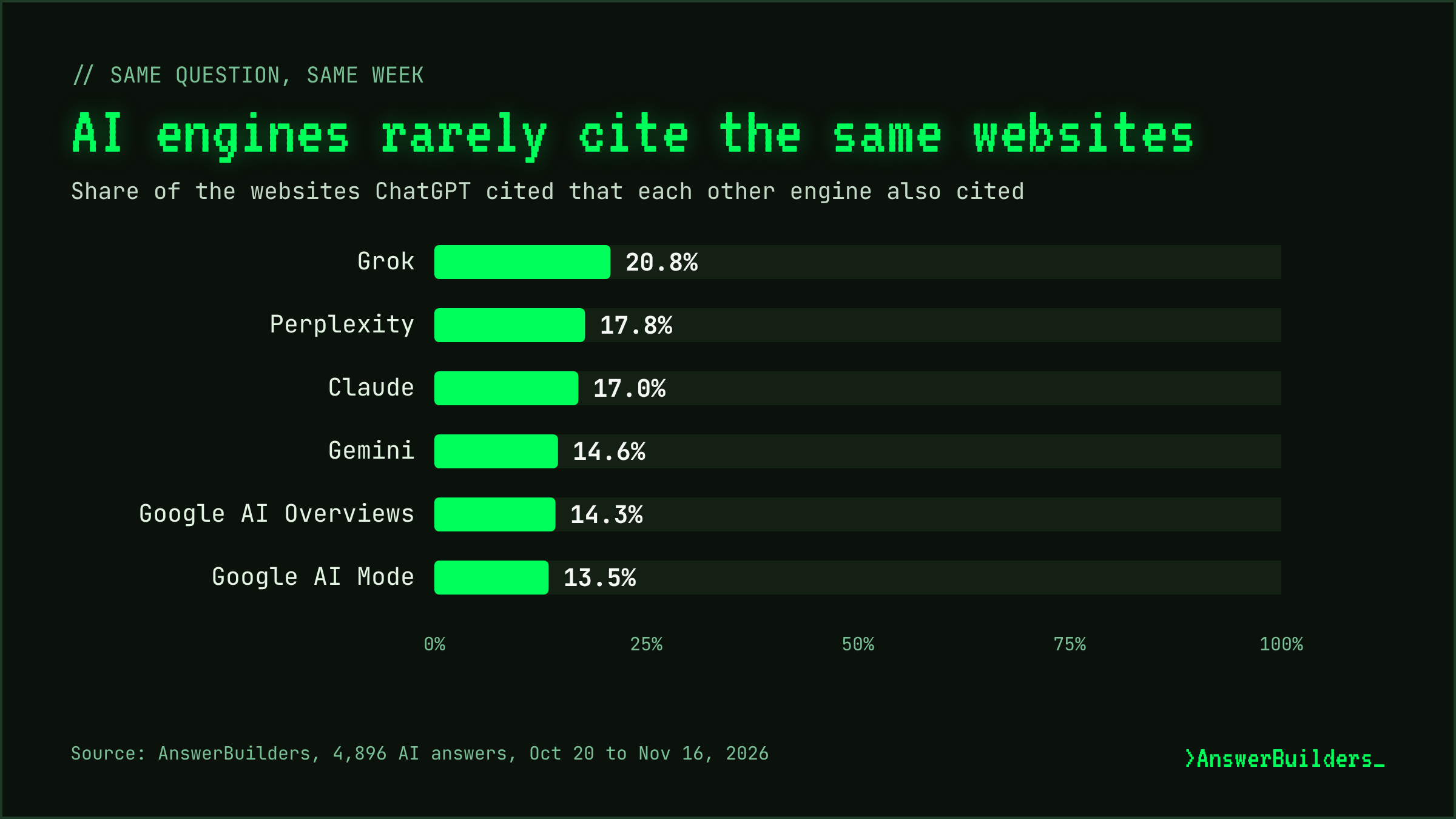
- > Engines rarely agree: for the same question in the same week, only 13.5% to 20.8% of the sites ChatGPT cited were also cited by another engine.
- > AI sources change fast: about a week later, only 37.6% of the sites cited for a question were cited again by the same engine.
- > Google's AI products lean on Reddit and YouTube. Reddit appeared in 9.6% to 13.2% of their answers, versus 0% to 0.9% for ChatGPT, Claude and Perplexity.
- > GEO builds on SEO rather than replacing it, but much of the work happens on third-party pages AI reads, not on your own website.
Ask ChatGPT for the best family dentist in your city and you will not get ten blue links. You will get a short answer that names three or four practices and points to a handful of sources. If your business is not one of those names, you are invisible to that customer, no matter how well your website ranks in Google.
That is the problem GEO tries to solve. This guide explains what GEO is, where the term came from, how AI engines pick their sources, and how GEO compares to SEO. It also shares what we learned from logging 4,896 real AI answers and 25,591 citations across seven AI engines, data you will not find in other GEO guides.
What GEO means in plain terms
GEO stands for generative engine optimization. A "generative engine" is any tool that writes an answer instead of handing you a list of links. Today that includes ChatGPT, Google AI Overviews, Google AI Mode, Gemini, Perplexity, Claude, Grok and Microsoft Copilot.
GEO is the work of getting your business named, recommended and cited inside those answers.
These tools do not make up their recommendations from nothing. When a question needs current or local information, most of them search the web, read a set of pages, and summarize what those pages say. So GEO comes down to two jobs:
- Find the pages AI reads when it answers questions about your type of business.
- Show up on those pages, both by getting your business mentioned on other sites and by making your own pages easy for AI to read and quote.
GEO is not geo-targeting
Search for "GEO" and you will also find results about geography. In marketing, geo-targeting means showing ads or content to people in a certain location. That is a different thing. In this guide, and in most marketing conversations since 2024, GEO means generative engine optimization.
Where the term came from
The name comes from a research paper titled GEO: Generative Engine Optimization, first published in November 2023 by researchers from Princeton University and IIT Delhi. It was later accepted at KDD 2024, a major data science conference.
The researchers built a test set of 10,000 search queries across 25 subject areas, then tried nine ways of rewriting web content to see which ones made a source show up more in AI answers:
| Method | What it does |
|---|---|
| Authoritative | Makes the text sound more persuasive and confident |
| Statistics Addition | Replaces vague claims with numbers |
| Keyword Stuffing | Repeats the search terms more often, like old-school SEO |
| Cite Sources | Adds references to credible sources |
| Quotation Addition | Adds quotes from credible sources |
| Easy-to-Understand | Simplifies the language |
| Fluency Optimization | Makes the writing smoother |
| Unique Words | Adds less common words |
| Technical Terms | Adds industry vocabulary |
Three findings from the paper still matter today:
- Evidence beats fluff. Adding quotations, statistics and source citations worked best. The top methods improved visibility by about 41% on one of the paper's measures.
- Keyword stuffing did not work. It scored slightly below the unchanged baseline, which is a useful warning for anyone tempted to reuse old SEO tricks.
- What works depends on the topic. The best method in one subject area was not always the best in another.
Since 2023, the industry has used several names for the same idea. We cover them in the section on GEO, AEO and other terms below.
Why GEO matters now
Three changes have made GEO a real business issue rather than a buzzword.
People are asking AI instead of searching. OpenAI reported in February 2026 that ChatGPT had reached 900 million weekly active users. Many of those conversations are the same questions people used to type into Google, including "who should I hire" questions.
AI summaries reduce clicks. A Pew Research Center study of 68,879 Google searches by 900 US adults found that people who saw an AI summary clicked a regular search result in 8% of visits, compared with 15% when no summary appeared. They clicked a link inside the AI summary in just 1% of visits. You can read the full findings in Pew's report on AI summaries. If the answer itself names your competitor, many buyers never scroll down to your listing.
Google's AI reads more widely than its rankings. Google says AI Overviews and AI Mode may use "query fan-out," running several related searches across subtopics to build one answer. Google says this lets it show a wider and more diverse set of links than a classic results page, which helps explain why AI answers often cite sites you would not see on page one. Google describes this in its guide to AI features and your website.
How AI engines decide which sources to cite
Each engine works a little differently, but most follow the same basic pattern.
- Understand the question. The engine works out what the person is really asking and often breaks it into several smaller searches.
- Retrieve pages. It searches the web or its own index and pulls back a set of pages that look relevant and trustworthy.
- Read and select. A language model reads those pages and picks the passages that best answer the question.
- Write the answer. It writes a summary, names businesses or products, and often lists the pages it used as citations.
Some answers skip the search step and come from what the model learned during training. In our data, 27.5% of ChatGPT answers listed no sources at all, which suggests a large share of answers still come from the model's built-in knowledge. Being well known across the web, over time, helps with those answers too.
The practical lesson is simple. If the pages an engine retrieves do not mention you, its answer usually will not either.
What our data from 4,896 AI answers shows
At AnswerBuilders, we send real buyer questions to AI engines every week and save every answer and every cited source. Between October 20 and November 16, 2026, we logged 4,896 AI answers across Google AI Mode, ChatGPT, Claude, Perplexity, Google AI Overviews, Grok and Gemini. Those answers cited 25,591 sources from 6,942 different websites, about five sources per answer.
Here is what stood out.
Most cited websites show up only once
Of the 6,942 websites cited, 4,434 were cited only one time. The 100 most cited websites drew about a third of all citations (34.5%). The rest came from a long tail of niche blogs, local guides, review roundups, directories and company pages.
This is good news for smaller businesses. You do not need to be featured on a famous national website to show up in AI answers. You need to be on the right pages for your specific questions, and those pages are often small, specialized sites that are easier to reach.
Each engine reads different sources
We compared the sources ChatGPT cited with the sources other engines cited for the exact same question in the same week. The overlap was small.
| Compared with ChatGPT | Share of ChatGPT's cited sites also cited by this engine | Answers with at least one site in common |
|---|---|---|
| Perplexity | 17.8% | 53.5% |
| Claude | 17.0% | 52.3% |
| Google AI Mode | 13.5% | 45.2% |
| Google AI Overviews | 14.3% | 47.9% |
| Grok | 20.8% | 60.1% |
| Gemini | 14.6% | 46.8% |
In plain terms, when you compare ChatGPT with any one of the other engines, roughly 80% or more of the websites ChatGPT relied on for a question were not used by the other engine for that same question. We saw the same pattern on a smaller scale in our Phoenix HVAC study, where three engines named 60 different businesses for five questions and not one business appeared in all three.
The takeaway: doing well in one AI engine tells you very little about the others. You have to check each one.
Google's AI leans on Reddit and YouTube
The engines also differ in the types of sources they trust. Google's AI products cited Reddit and YouTube far more often than the others did.
| Engine | Average sources per answer | Answers with no sources | Answers citing Reddit | Answers citing YouTube |
|---|---|---|---|---|
| Gemini | 7.2 | 2.7% | 13.2% | 6.1% |
| Grok | 6.9 | 0.0% | 0.7% | 0.7% |
| Google AI Overviews | 6.0 | 27.4% | 11.1% | 13.6% |
| Claude | 5.9 | 9.5% | 0.0% | 0.0% |
| ChatGPT | 5.6 | 27.5% | 0.9% | 0.1% |
| Perplexity | 5.1 | 0.1% | 0.4% | 0.0% |
| Google AI Mode | 2.5 | 17.9% | 9.6% | 1.9% |
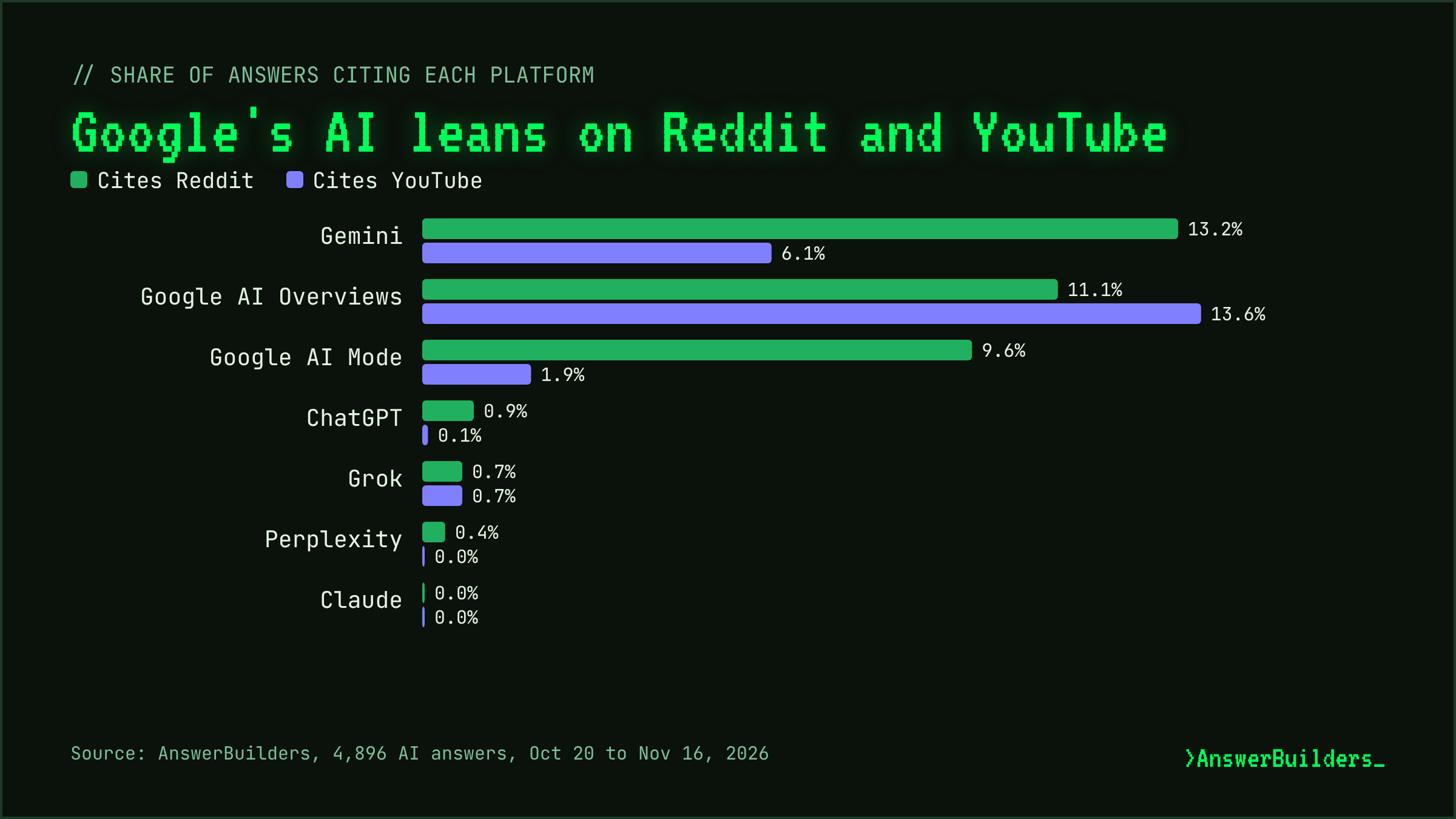
If Google is where your buyers search, real participation on Reddit and useful YouTube videos may matter more than they would for ChatGPT or Claude. (For AI Overviews, "no sources" usually means Google did not show an AI Overview for that question.)
AI sources change fast
We also tracked the same question in the same engine from one run to the next, about eight days apart on average. Only 37.6% of the websites cited in the first answer were cited again in the next one. In other words, close to two thirds of the sources changed in about a week.
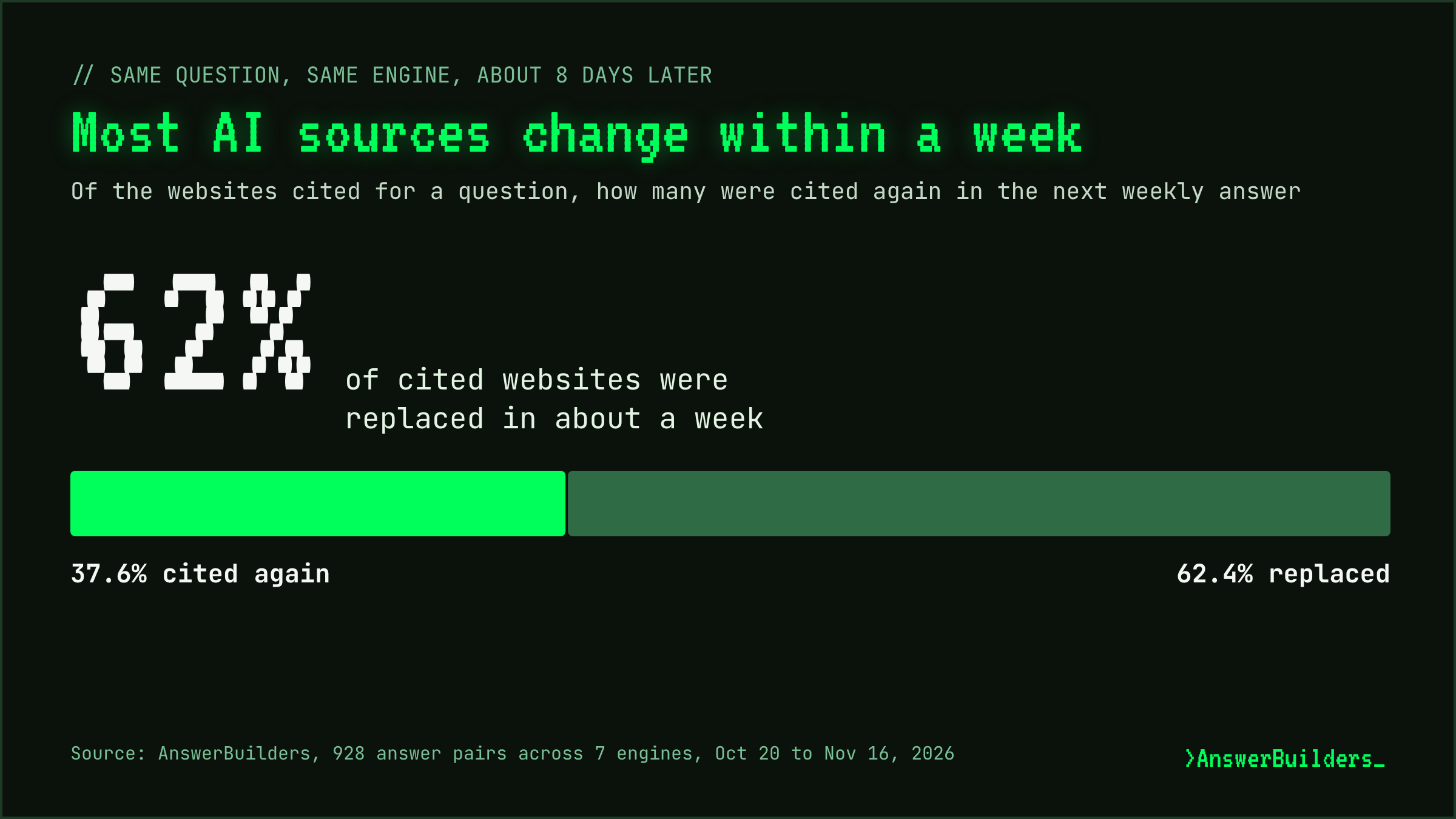
That has two sides. A single check of ChatGPT tells you little, because the answer may be different next week. But it also means the door is never closed. New pages can earn a spot quickly, and a competitor's lead is not permanent.
Community and review platforms show up often
Across all engines, these were the most cited large community and review platforms:
| Platform | Times cited |
|---|---|
| 276 | |
| YouTube | 240 |
| 158 | |
| Trustpilot | 123 |
| 114 | |
| Yelp | 72 |
| Clutch | 67 |
| Quora | 66 |
| Wikipedia | 40 |
| G2 | 20 |
Which platforms matter most depends on your industry. A local plumber should care more about Yelp and local guides, while a software company should care more about G2 and industry blogs.
GEO vs SEO: what changes and what doesn't
GEO does not replace SEO. It builds on it. Google says plainly that its AI features have no special requirements and that existing SEO fundamentals still apply. At the same time, the goal, the competition and the way you measure success all shift.
What stays the same
- Crawlable, indexable pages. If search engines and AI crawlers cannot reach your page, it cannot be cited.
- Helpful, accurate content. Both Google and AI engines favor pages that answer the question clearly and correctly.
- Authority and trust. Links, mentions, reviews and a solid reputation help in both.
- Clear structure. Good headings, short paragraphs, lists and tables help both search engines and AI models understand a page.
What changes
| SEO | GEO | |
|---|---|---|
| What the user sees | A list of ranked links | A written answer with a few sources |
| Typical search | Short keywords | Longer, conversational questions |
| Goal | Rank your pages | Get your business named in the answer |
| What you compete with | Other pages | Other businesses' names, often on pages you do not own |
| Biggest lever | Your own content and backlinks | Being included on the third-party pages AI reads |
| What you track | Rankings, clicks, traffic | Mentions, share of voice, cited pages, AI referrals |
| How fast results move | Rankings shift over weeks and months | Cited sources can change week to week |
| Engines to watch | Mostly Google, some Bing | ChatGPT, Google AI Overviews and AI Mode, Gemini, Perplexity, Claude, Grok, Copilot |
The biggest difference is where the work happens. In SEO, most of the effort goes into your own website. In GEO, a large share happens on other people's websites. In our Phoenix HVAC study, about half of all citations pointed to sites the businesses did not own.
Is GEO replacing SEO?
No. Many AI engines use search indexes to find their sources, so strong SEO makes your pages more likely to be read. Think of SEO as the foundation and GEO as the next floor. A business that ignores SEO will struggle with GEO, and a business that only does SEO will miss a growing share of buyers who never see a results page.
GEO, AEO, LLMO and AI SEO: are they different?
You will see several names for this work. In practice, they mean almost the same thing.
- GEO (generative engine optimization): the term from the 2023 research paper, focused on AI tools that write answers.
- AEO (answer engine optimization): an older term, first used for featured snippets and voice assistants, now applied to AI answers.
- LLMO (large language model optimization): focuses on how language models understand and mention a brand.
- AI SEO or AI search optimization: a plain-English label many agencies use for the same work.
The names differ, but the goal is the same: be the business AI recommends. Do not let the label confuse you or pay extra for a new acronym.
How to do GEO: a step-by-step plan
You do not need a large budget to start. You need to know what AI says about your market today, and why.
1. Build a list of the questions your buyers ask
Write down 20 to 30 questions a customer might ask an AI tool before choosing a business like yours. Mix in "best" questions ("best roofing company in Denver"), problem questions ("who fixes a leaking water heater"), cost questions ("how much does a new roof cost in Denver") and comparison questions. Leave your brand name out. You want to know whether AI recommends you when the buyer has never heard of you.
2. Measure where you stand today
Ask each question in several engines and record who gets named and which pages get cited. Because answers change often, run each question more than once, or on a schedule, before drawing conclusions. This is your baseline.
3. Find the pages AI reads for your questions
Look at the cited sources across all your questions. Group them by type: local "best of" lists, review sites, directories, industry blogs, news articles, forums and competitor pages. The sites that show up again and again are your targets.
4. Make your own pages easy for AI to read and quote
- Answer first. Put a clear, direct answer in the first sentence or two of each section.
- One idea per paragraph. Self-contained paragraphs are easier for AI to lift and quote.
- Add specific facts. Prices or price ranges, service areas, years in business, licenses and certifications. The original GEO research found statistics and cited sources helped most.
- Use real tables and lists, not images of text.
- Show who wrote it and when. Add an author name and a "last updated" date, and keep key pages current.
- Use structured data that matches the page. Google says no special schema is needed for AI features, but your structured data should match what is visible on the page.
- Let AI crawlers in. Check that your robots.txt file does not block crawlers such as GPTBot, OAI-SearchBot, PerplexityBot and ClaudeBot, and that your key content loads without JavaScript.
- Build one page per service and location. In our Phoenix HVAC study, most of the contractor pages AI cited were built for one service in one city, such as an emergency repair page or a local cost guide, rather than a generic home page.
5. Get included on the third-party pages AI already reads
This is the step most businesses skip, and often the one that makes the biggest difference.
- Ask to be added to the local lists, roundups and directories that keep showing up in your answers.
- Earn reviews on the review platforms AI cites for your industry.
- Pitch useful facts to the writers of industry articles and guides, especially if you have original data or expert tips.
- Join conversations honestly on Reddit and other forums. Answer questions as yourself. Spam gets removed and can hurt your reputation.
- Publish helpful video if Google AI Overviews matter to you, since YouTube shows up often in Google's AI answers.
6. Track it every week
Run the same questions on a schedule and watch how your mentions and cited pages change. With sources shifting this quickly, weekly tracking is the only way to know whether your work is paying off.
AnswerBuilders handles steps 1 to 3 and step 6 automatically, and offers step 5 as a done-for-you outreach service. You can see how it works or run a free report for your business.
How to measure GEO
GEO needs its own scorecard. Rankings and organic traffic still matter, but they do not tell you whether AI is recommending you.
| Metric | What it tells you |
|---|---|
| Mention rate | The share of your questions where AI names your business |
| Share of voice | How often you are named compared with competitors |
| Citation rate | How often AI links to one of your own pages as a source |
| Cited pages | Which third-party pages AI uses for your questions, and whether you appear on them |
| AI referral traffic | Visits from sites like chatgpt.com, perplexity.ai and gemini.google.com in your analytics |
| Branded search | Whether more people search for your name after seeing you in AI answers |
Two notes on measurement. First, Google counts traffic from AI Overviews and AI Mode inside the normal "Web" numbers in Search Console, so you cannot separate it there. Second, because AI answers vary, measure trends over several weeks rather than reacting to a single check.
GEO for local and small businesses
Most GEO guides are written for big brands and software companies. Local businesses have some real advantages.
- Local questions pull from local pages. Questions like "best HVAC company in Phoenix" are answered with city guides, local lists, review sites and contractor pages, not national media.
- The sources are reachable. The long tail in our data means many cited sites are small publishers, local bloggers and directories that will respond to a polite request.
- Licenses and reviews count. In our Phoenix HVAC study, ChatGPT linked to the state contractor license database in three of five answers. Keep your license, reviews and business details accurate everywhere.
- Specific pages win. A page for "emergency AC repair in Phoenix" beats a generic services page when someone asks that exact question.
GEO tactics that backfire
- Keyword stuffing. It did not help in the original research and can make your pages read worse.
- Fake reviews or paid forum spam. Platforms remove it, and AI engines learn from what remains. It can damage your reputation in AI answers for a long time.
- Blocking AI crawlers by accident. Some security settings and robots.txt rules block AI bots without the owner knowing.
- Hiding content behind JavaScript, logins or images. If a crawler cannot read the text, it cannot quote it.
- Paying for low-quality "best of" lists. If a list only exists to sell placements, AI engines may not trust it, and you may waste money.
- Optimizing for one engine only. Our data shows engines rarely agree. Winning ChatGPT alone leaves most of the field open to competitors.
- Judging results from one check. Answers change week to week, so a single test can mislead you in either direction.
How long GEO takes
There is no fixed timeline, and anyone who promises one is guessing. Two things from our data help set expectations. Because cited sources change so often, a new mention on a page AI already trusts can start showing up within weeks. Building enough reputation that AI mentions you from memory takes much longer, often months. Plan for a steady effort and measure it monthly.
What GEO costs
You can start for free by asking AI tools your questions yourself and writing down the answers. The limits show up quickly, though. There are many engines, the answers change every week, and tracking dozens of questions by hand takes hours.
Most businesses end up choosing between three paths:
- Do it yourself with a spreadsheet and regular manual checks.
- Use a tracking tool that runs your questions across engines and records mentions and sources.
- Hire a done-for-you service that tracks your visibility and also does the outreach to get you onto the pages AI reads.
AnswerBuilders offers a free first report, paid credits for ongoing tracking, and a done-for-you outreach program. Current prices are on our pricing section.
The bottom line
GEO is not a replacement for SEO, and it is not magic. It is the practical work of finding the pages AI reads and making sure your business shows up on them. The engines disagree, the sources change every week, and many of the pages that matter are small sites you can reach. That makes it one of the few areas in marketing where a focused small business can still beat a much bigger competitor.
// METHODS
- Data: every AI answer AnswerBuilders logged between October 20 and November 16, 2026, for the businesses and markets we track: 4,896 answers with no errors.
- Engines: Google AI Mode (899 answers), ChatGPT (890), Claude (854), Perplexity (841), Google AI Overviews (821), Grok (296) and Gemini (295), queried through their APIs in US English. Grok and Gemini have smaller samples.
- Citations: 25,591 cited sources across 6,942 websites, counted by website domain.
- Engine overlap: for each question answered by ChatGPT and another engine in the same weekly run, we measured the share of ChatGPT's cited websites that the other engine also cited, then averaged across questions (220 to 592 question pairs per engine).
- Source turnover: for each question and engine, we compared consecutive answers at least three days apart (928 pairs, about 8.3 days apart on average) and measured the share of cited websites that appeared again.
- Limits: questions come from the industries we track, a mix of local service, professional service and online businesses, so results will differ by industry. An answer with no sources may mean the engine answered from memory or, for AI Overviews, that no overview was shown. Business and client names are not included.
- Outside sources: the original GEO paper (Aggarwal et al., KDD 2024), Pew Research Center (July 2025), Google Search Central documentation, and OpenAI user figures as reported by TechCrunch (February 2026).
FAQ
What does GEO stand for in marketing?
GEO stands for generative engine optimization. It is the work of getting a business named and cited in answers from AI tools like ChatGPT, Google AI Overviews, Google AI Mode, Gemini, Perplexity and Claude. It is not the same as geo-targeting, which means targeting people by location.
Is GEO replacing SEO?
No. Many AI engines use search indexes to find their sources, so strong SEO makes your pages more likely to be read. GEO builds on SEO and adds new goals, such as being named inside AI answers and appearing on the third-party pages AI cites.
Is GEO the same as AEO?
In practice, yes. AEO (answer engine optimization), LLMO, AI SEO and AI search optimization are different names for the same goal: being the business AI recommends.
Do I need special schema markup for GEO?
Google says there is no special structured data needed to appear in AI Overviews or AI Mode. Use standard structured data where it fits, and make sure it matches what is visible on the page.
Should I block AI crawlers from my website?
Only if you do not want AI tools to read and cite your content. If you want to be recommended, allow crawlers such as GPTBot, OAI-SearchBot, PerplexityBot and ClaudeBot, and check that security settings are not blocking them by accident.
How long does GEO take to work?
There is no fixed timeline. In our data, the sources AI cites change often, so a new mention on a page AI already trusts can show up within weeks. Building a reputation strong enough that AI mentions you from memory usually takes months.
How do you measure GEO?
Track how often AI names your business for your buyers' questions (mention rate), how you compare with competitors (share of voice), which pages AI cites, how often it cites your own pages, and visits from AI tools in your analytics. Measure trends over several weeks, because answers vary.